In development projects, it is easy to count what has been done: the number of training courses run, people reached, kits handed out or meetings held.
Those figures are useful. They allow implementation to be tracked and operational commitments to be checked.
But one essential question remains: what has actually changed in people's lives?
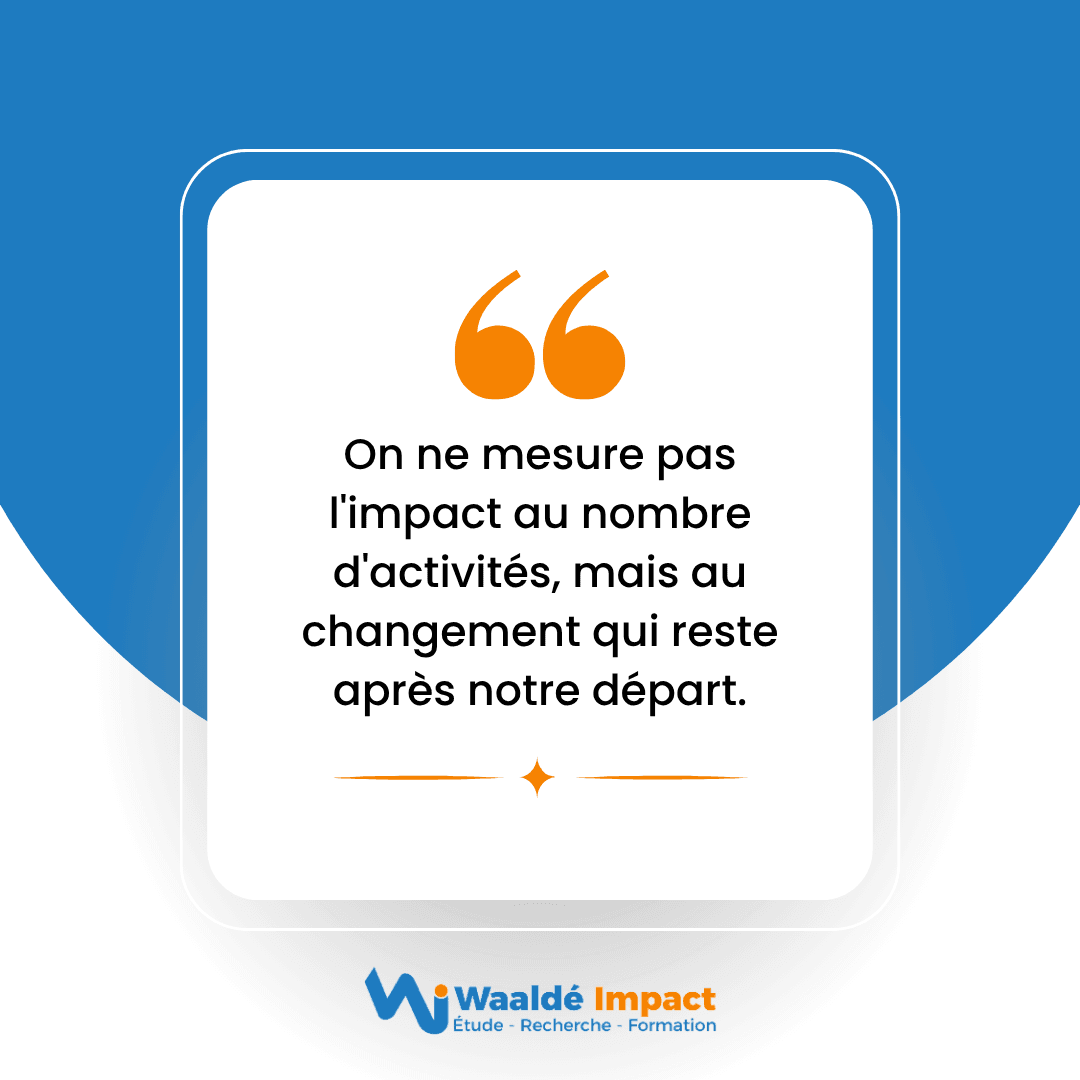
“Impact is not measured by the number of activities, but by the change that remains after we leave.”
That thought invites us to go beyond counting what was delivered, and to look at the changes produced and at how long they last.
Activities, results and impact: what is the difference?
To understand how a project performs, several levels of result have to be told apart.
1. Activities: what we do
These are the actions carried out: training courses, awareness campaigns, distributions, support visits or coaching sessions.
2. Outputs: what we produce
These are the immediate products of the activities: the number of people trained, the quantity of equipment distributed, the number of sessions held.
3. Outcomes: what changes in the short or medium term
These concern the changes observed in people's knowledge, behaviour, practices or living conditions.
4. Impact: the wider changes the project contributes to
These may be lasting changes in living conditions, health, income, resilience or well-being.
The levels are linked, but they are not interchangeable. Carrying out every planned activity does not automatically produce the expected outcomes.
A concrete example: vocational training
Imagine a project that trains 500 young people in entrepreneurship.
At the end of the project, the report states that 500 young people attended the training. The output target has been met.
But can we conclude that the project improved their economic situation?
Not yet.
Several things have to be found out:
Did participants acquire the expected skills?
Are they using those skills in their work?
Have they started or grown an economic activity?
Has their income changed?
Do the changes observed hold over time?
The number of people trained is an important piece of information, but it is not enough to demonstrate lasting economic change.
Measuring activities tells us what we did. Measuring outcomes tells us what our work changed.
Why does sustainability matter?
A project can achieve good results while it is funded, and then watch those results fade once it closes.
An income-generating activity can stop. A practice that was taught can be abandoned. A community mechanism can cease to function for want of resources.
That is why the continuity of change deserves to be questioned.
Sustainability depends, among other things, on local capacity, on ownership by the people concerned, on the resources available, on the institutional environment and on how well the solutions fit.
The aim is not only to produce change while the project runs, but to create the conditions in which that change can hold.
How can a project's impact be measured better?
A rigorous approach rests on several elements.
1. State clearly the change being sought
Before choosing indicators, it must be said what the project intends to change, for whom and under what conditions.
2. Build a theory of change
It sets out the expected links between activities, outputs, outcomes and impact, as well as the assumptions those links rest on.
3. Define relevant indicators
Indicators must measure not only the activities carried out but also the changes expected. They need baselines, targets and suitable collection methods.
4. Compare results over time
Baseline, monitoring and final evaluation data make it possible to examine how indicators move. Where it is relevant and feasible, more robust methods can help estimate the project's own contribution to the changes observed.
5. Listen to the people concerned
Quantitative data show trends, while qualitative approaches help to understand lived experience, the obstacles met and the mechanisms behind the changes.
6. Examine whether results endure
Where conditions allow, following up after the project has closed helps to establish whether the changes hold.
The real challenge: learning in order to work better
Measuring impact is not only about satisfying a funder's requirements or producing a final report.
It is also about understanding what works, for whom, under what conditions and why.
That knowledge makes it possible to improve strategies, use resources better and steer future work.
Rigour is still required, however: observing an improvement after a project is not by itself proof that the project caused it. Other factors may also be at play.
The quality of an evaluation therefore rests on suitable methods, reliable data and a cautious reading of the results.
Conclusion: beyond the figures, the changes that count
A project should not be judged solely on the number of activities carried out or people reached.
Those figures are necessary, but they must be completed by an analysis of the changes obtained and of the conditions that allow them to last.
The fundamental question is therefore not only: “How much did we deliver?”
It is also: “What changed, for whom, and can that change last?”
By placing those questions at the heart of monitoring and evaluation, organisations can understand their results better and make their work more relevant.
Waaldé Impact
We support organisations in their needs for studies, research, monitoring and evaluation, data analysis, training and consulting.
📍 Secteur 22, Ouagadougou, Burkina Faso
📧 waaldeimpact@gmail.com
📞 +226 25 46 52 75 | +226 70 59 08 68
📞 +226 75 97 74 67 | +226 70 69 44 43 | +226 75 69 90 53