In the world of development projects and programmes, the word “evaluation” is sometimes misunderstood.
Evaluating does not simply mean looking for what went wrong, identifying who is to blame or giving a project a mark.
Evaluating is, above all, learning.
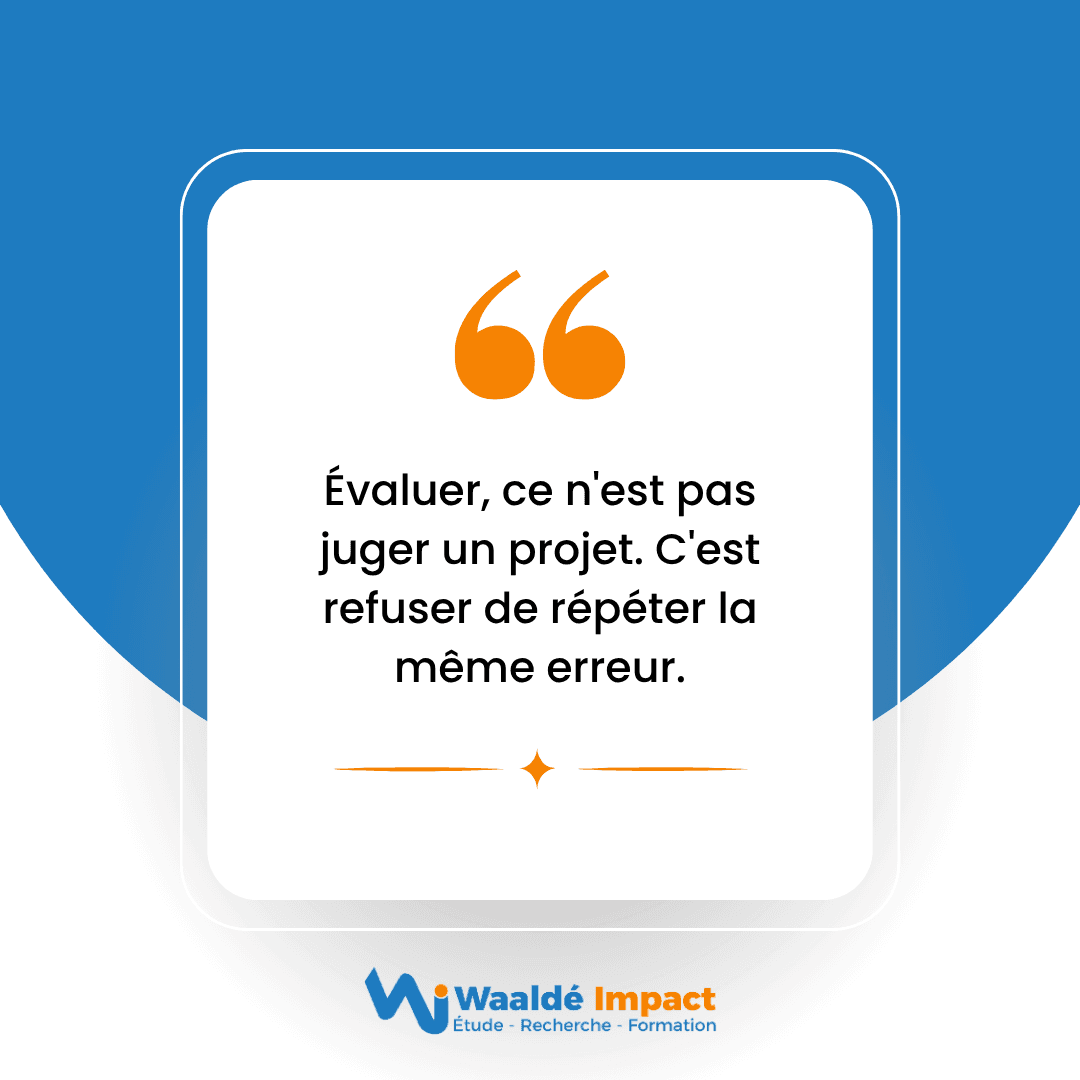
“Evaluating is not passing judgement on a project. It is refusing to repeat the same mistake.”
That idea sums up an essential dimension of monitoring and evaluation: turning experience into knowledge that improves the decisions still to come.
Why evaluate a project?
A project may have been well designed and still run into difficulty once it is under way.
Conditions on the ground change, the needs of those involved change, some of the initial assumptions turn out to be wrong, and unforeseen constraints appear.
Evaluation is what allows the essential questions to be answered:
Were the objectives reached?
What results were actually achieved?
For which beneficiaries?
What worked?
What did not work?
Why?
What effects did the project produce?
Were the resources used efficiently?
What must we improve next time?
The aim is therefore not only to record a result.
It is to understand why that result was obtained.
A poor evaluation looks for culprits
An evaluation designed as a judgement quickly becomes counterproductive.
If teams believe that an evaluation serves mainly to pin down individual mistakes, they will be tempted to play down the difficulties they met, or to present only the positive results.
Yet an organisation that cannot speak openly about its difficulties is bound to reproduce them.
A good evaluation should instead open a space where successes and failures can both be understood.
An evaluation must produce learning
A useful evaluation should not end with a report filed on a shelf or in a folder.
It should lead to decisions.
For example:
Finding → Analysis → Lesson learned → Recommendation → Decision → Action
Take a simple case.
A project finds that attendance at an activity is far below target.
The evaluation must not simply conclude:
“The target was not reached.”
It has to seek out the reasons:
Was the target realistic?
Did the activity really answer a need?
Were the times of day suitable?
Did the people concerned have enough information?
Did economic or social constraints limit their participation?
Was the outreach strategy the right one?
That analysis is what then makes better decisions possible.
Evaluation as a tool for continuous improvement
In an organisation that learns, evaluation is not the end of a project.
It becomes a source of information for the next one.
The lessons drawn from it can serve to:
improve the design of interventions;
adjust indicators;
revisit certain strategies;
target beneficiaries more accurately;
improve the allocation of resources;
strengthen monitoring arrangements;
anticipate certain risks;
repeat the approaches that worked.
Evaluation then becomes a tool for capitalising on experience and improving continuously.
Evaluating to decide, not only to report
This is perhaps where the real stake lies.
An organisation can produce a great many reports, collect a great deal of data and carry out several evaluations without its work improving at all.
The fundamental question remains:
What are we going to do with what we have learned?
A recommendation with no owner, no deadline and no decision attached to it is likely to remain a sentence in a report.
Learning must therefore be tied to action.
Conclusion
Evaluating a project is not about showing that it was perfect, nor that it failed.
It is about understanding what happened, why it happened, and what we can do differently tomorrow.
An organisation that agrees to evaluate its work also agrees to question its own practice.
And above all, it gives itself the means to improve.
Because an evaluation only takes on its full meaning when it turns experience into decisions, and decisions into improvement.
Waaldé Impact
Study • Research • Training
We support organisations in their needs for studies, research, monitoring and evaluation, data analysis, training and consulting.
📧 waaldeimpact@gmail.com
📍 Secteur 22, Ouagadougou, Burkina Faso
📞 +226 25 46 52 75 | +226 70 59 08 68
📞 +226 75 97 74 67 | +226 70 69 44 43 | +226 75 69 90 53